
spring 2025
AGENT EXPERIENCE SERVICE BLUEPRINT
Company: Ford Credit
Timeframe: 17 weeks
Role: Sole researcher
Stakeholders: Transformation team (Transformation Director, Transformation Product Managers)
Method: Service Design, Co-Creation
Tools: Miro, Dovetail
OVERVIEW
PROJECT DESCRIPTION
Ford Credit is undergoing a digital transformation, modernizing its legacy backend systems to a new platform to improve overall efficiency and the customer experience. This initiative focuses on the Own and Renew phases of the customer journey, with the goal of creating a streamlined, automated, and self-service experience.
I led the user research to map the end-to-end journey of how agents service customer accounts. This research was used to build a comprehensive future-state Service Blueprint, visually mapping customer actions, employee workflows, backend systems, and third-party dependencies across the account lifecycle. This blueprint identifies key problems and opportunities to optimize the new platform implementation, ensuring it supports both internal teams and customer needs.
PROBLEM
While planning for the future-state platform, the organization lacked a unified, end-to-end view of the current agent servicing experience. Because processes, legacy systems, and departmental handoffs were managed in silos, it was difficult to identify the root causes of daily operational friction, manual workarounds, and the resulting downstream customer pain points that needed to be addressed in the transition.
APPROACH
QUESTIONS
What are the biggest opportunities to optimize the end-to-end process within the Own/Renew journey?
What are the desired customer and employee experiences, expectations, and key interactions within the future state of the Own/Renew journey?
What tools, information, and support do Ford Credit employees require to effectively assist customers and optimize their performance within the Own/Renew journey?
What are the critical backstage actions, systems, and data requirements necessary to support the future state Own/Renew journey?
OBJECTIVES
Identify and document the future-state workflows of front-line and back-office agents
Proactively uncover potential obstacles, system friction, and operational challenges within the proposed processes
Test early-stage design concepts with agents to gather feedback on how the new platform could best support their daily tasks
PROCESS
BUSINESS PROCESS MAP REVIEW
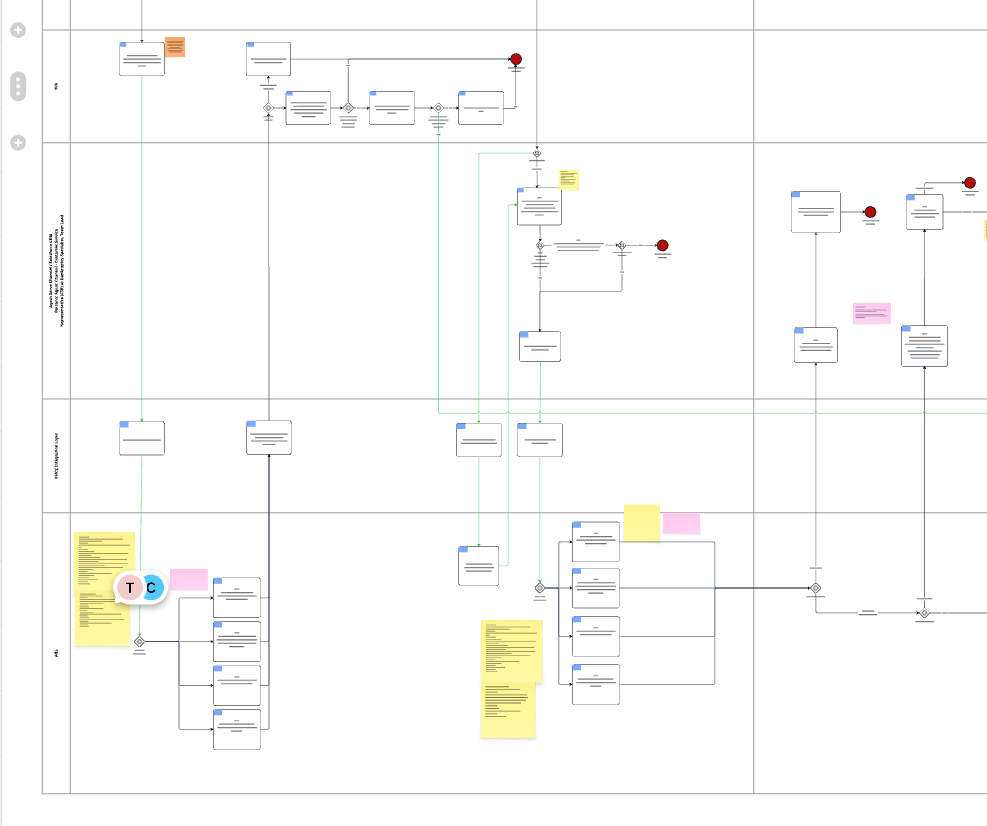
Example of a business process map
Before speaking with employees, I conducted a thorough review of the organization’s existing business process maps. This desk research phase allowed me to understand the baseline workflows, identify operational friction points, and design a highly targeted interview guide for our primary research sessions.
MODERATED CO-CREATION SESSIONS
Participants
To ensure our future-state blueprint was accurate and viable across multiple departments, we engaged 21 participants spanning three specialized operational groups:
Operating Managers & Team Leads: Leaders overseeing customer service, account management, and specialized back-office support
Front-Line Agents: Customer service representatives who handle high-volume queues and daily customer account updates
Specialized Back-Office Agents: Specialized teams responsible for high-stakes account operations, including end-of-term financing, complex billing, collections, and loss prevention
Test details
I conducted 60-minute moderated virtual sessions over Microsoft Teams. The sessions were split into three structured segments:
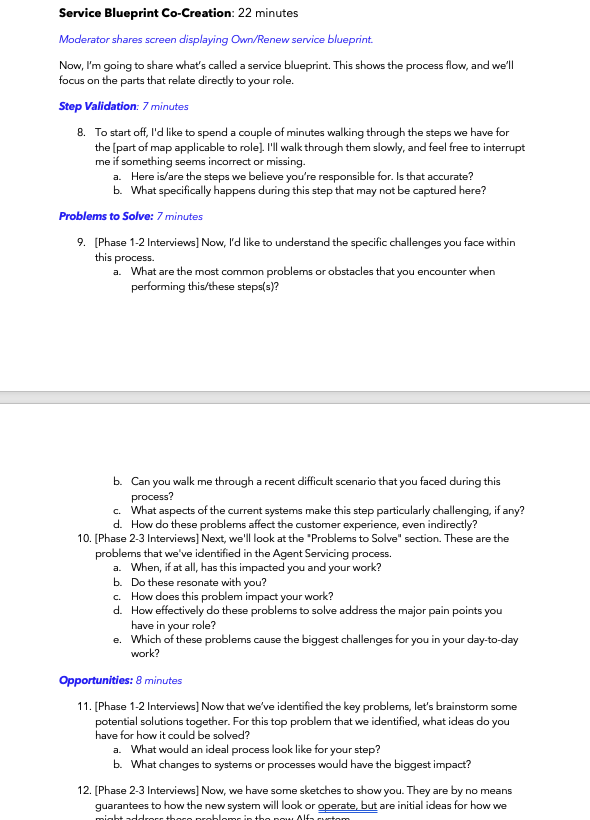
Excerpt from the Moderated Discussion Guide
Role Deep Dive: A qualitative interview to understand the agent’s typical day, key priorities, and performance metrics to help build operational user profiles.
Future-State Step Validation: I shared my screen to walk through the proposed future-state blueprint draft. Agents validated whether the steps assigned to their roles were accurate and highlighted any undocumented workarounds that had been missed.
Concept Testing:
Early sessions: We brainstormed potential solutions for key pain points.
Later sessions: We presented software prototypes of the proposed modernized platform to gather feedback on usability, potential workflow issues, and missing capabilities.
ANALYSIS
Because of the highly collaborative nature of this project, our analysis phase was lean and focused heavily on co-creation and synthesis. All sessions were recorded, transcribed, and uploaded into our centralized research repository, Dovetail.
I synthesized qualitative data by identifying recurring themes around system limitations, process bottlenecks, and emotional stress points. These findings were directly mapped onto our live Miro Service Blueprint to highlight exactly where “Problems to Solve” existed. Rather than generating static, text-heavy reports, we embedded these insights directly into the final, interactive Service Blueprint. This allowed our product partners to see real, direct user feedback contextually linked to specific system touchpoints on the map.
outcome
findings
Through our conversations with agents, we found that because they had to juggle so many different tools and legacy systems to do their daily jobs, they had created a lot of manual, undocumented workarounds just to keep things moving. By mapping these steps out, we were able to clearly show where the new platform could actually automate their work versus where they still needed human intervention to handle unique customer situations.
To make sure this research was actually practical and easy to use, we built the qualitative insights directly into the blueprint itself. Instead of sharing a separate, lengthy research report, we structured the findings into dedicated swimlanes running along the bottom of the map. We framed agent pain points as “Problems to Solve” and highlighted proposed system improvements as “Opportunities.” This allowed product managers to easily scan the workflo and see exactly where the process was broken and where the new platform designs could help.
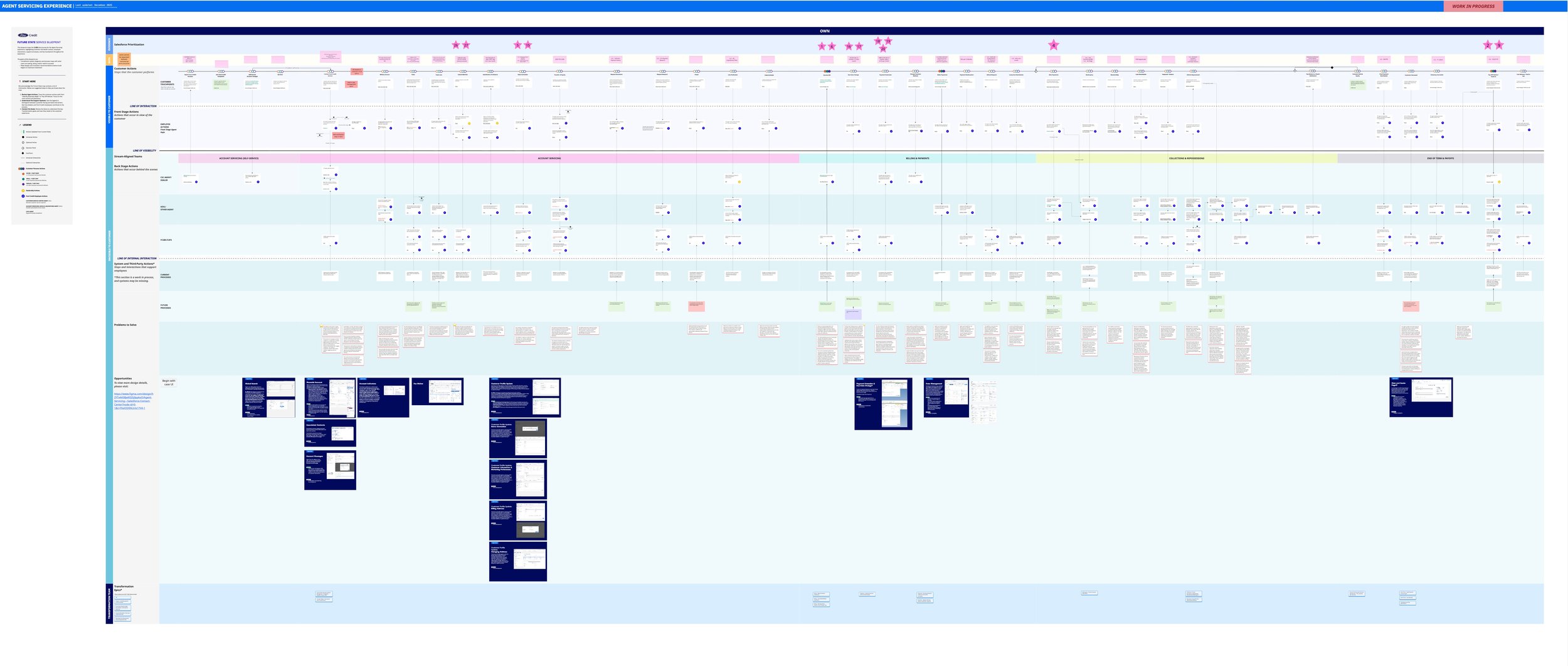
Final agent servicing service blueprint
IMPACT
The primary value of this project was creating a shared understanding across teams that had historically worked in silos. For the first time, product managers, designers, and operations teams had a single, highly visual map to reference when discussing how a system change would affect an agent’s day-to-day work.
Beyond guiding the immediate platform transition, the map is being actively consumed across the organization. It has become a foundational resource, serving as a baseline for other UX members who are now mapping out related parts of the servicing experience and using this blueprint as their starting point.
reflection
What I’d Change:
Break down the complex blueprint into smaller, sub process maps to make it less overwhelming and easier for specific teams to digest
Set up a clear process for updating the blueprint as software designs and backend requirements continued to evolve after the research phase ended
What went well:
Engaging front-line agents directly in the sessions ensured our workflow data was highly accurate and made employees feel valued and heard during a major system transition
Organizing findings into dedicated “Problems to Solve” and “Opportunities” swimlanes turned the blueprint into a living, visual tool that teams actively reference, rather than a static research report